

Drip irrigation from a barrel: gravity feed without a pump or electricity
How to choose the height, tape type, and length limitations for a gravity-fed system. Practical tips for gardens without electricity.
How it works and its limitations
A gravity-fed system relies on hydrostatic pressure: the column of water above the outlet creates pressure. 1 meter of water = 0.098 bar (≈ 0.1 bar).
| Barrel height | Pressure generated | What will work |
|---|---|---|
| 1 м | 0.1 бар | Single-hole emitters (basic) |
| 2 м | 0.2 бар | 1.0 L/h tape, short rows up to 10 m |
| 3 м | 0.3 бар | 1.0–1.3 L/h tape, rows 15–20 m (recommended minimum) |
| 5 м | 0.5 бар | 1.6 L/h tape, rows up to 30 m, stable operation |
| 10 м | 1.0 бар | Normal pressure equivalent to municipal supply, all tape types |
Minimum for effective operation: a 200 L barrel at 3 m above the level of the farthest bed. Below 2 m, irrigation will be uneven and the tape will barely function.
Which tape type to choose
- Height 2–3 m: 1.0 L/h tape, 30 cm spacing, rows up to 15 m. Flat emitters with a larger channel are preferable
- Height 3–5 m: 1.3–1.6 L/h tape, 20 cm spacing, rows up to 25 m. Standard 8 mil garden tape
- Height 5+ m: any 1.6–2.0 L/h tape, rows 30–50 m
- DO NOT use PC tape for gravity feed: pressure-compensating emitters require a minimum of 0.5 bar to open the diaphragm. At 0.2–0.3 bar, they will not work at all.
Step-by-step installation
Set up the barrel stand
A metal frame made of 40×40 angle iron or a brick tower. A full 200 L barrel weighs 200 kg — the stand must support 300 kg with a safety margin. Minimum height is 2 m for a home garden, optimal is 3–5 m.
Drill a hole and install the fitting
In the lower part of the barrel (5–10 cm from the bottom), drill a hole for a 1/2" (22 mm) or 3/4" (27 mm) fitting. Install a through-wall fitting with rubber gaskets on both sides. Tighten the nut from the inside and outside. Test for leaks by filling with water.
Install the filter and valve
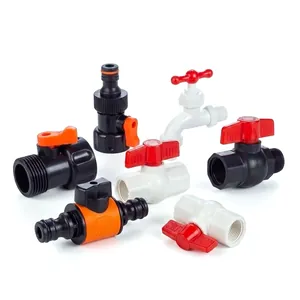
After the fitting: ball valve (to shut off water) → 120 mesh screen filter (mandatory — sediment always accumulates in the barrel) → 16–20 mm mainline hose to the beds.
Important: Gravity-fed systems are especially prone to clogging — sediment, leaves, silt. CLEAN the filter every 3–5 days.
Lay the mainline and drip tape
16–20 mm mainline to the beds. Start connectors in the mainline. 1.0–1.6 L/h drip tape along the beds. Tape ends sealed with end caps. Position the mainline along the lower edge of the plot to gain an extra 0.05–0.1 bar from the elevation difference.
First run and calibration
Fill the barrel, open the valve fully. Observe for 15–20 min: water should come out of all emitters (some unevenness is normal for gravity feed). Watering time — 2–3 hours per day (long cycles compensate for low flow).
Tips for gravity-fed irrigation
- Black barrel: water warms up to 20–25°C during the day — better for tomatoes and cucumbers than cold 10°C well water
- Long watering cycles: run for 2–3 hours (instead of 30 min with a pump) — compensates for low flow
- Manual barrel refill: once a day by bucket from the tap or by collecting rainwater from the roof through a gutter
- Auto-refill from the tap: a float valve (like in a toilet tank) — the barrel refills automatically from the water supply
- Lid on the barrel: keeps out leaves, insects, and debris — reduces sediment and extends the interval between filter cleanings
- Battery-powered timer: Galcon 9001, Rain Bird 1ZEHT — runs without electricity, automatically starts watering daily at a set time
Common problems and solutions
- Uneven watering: normal for gravity feed (0.3–0.5 bar). Solution — raise the barrel to 5 m, or divide the beds into zones with separate tape lines
- Not enough water: 200 L for 1,000 m² = 2 L/m² — too little. You need a 500–1,000 L barrel or auto-refill from the tap
- Algae growth in the barrel: green water from algae in sunlight. Solution: lid, black barrel, treat the barrel with chlorine once every 1–2 months
- Freezing in winter: always drain for winter, otherwise ice will crack the barrel and fitting. Gravity-fed systems are usually disassembled for winter
For farms and remote plots without electricity
Gravity-fed systems in a commercial context are a solution for plots without reliable power, remote greenhouses, and farm apiaries.
- Tower tanks of 1,000–5,000 L on a 6–10 m support structure serve as a mainline for 0.5–2 ha of drip irrigation
- Solar pumps with a battery charge the tank during the day; gravity distributes water around the clock
- For commercial systems, a 150 mesh disc filter and anti-clog emitter tape (Netafim Streamline, Rivulis T-Tape) are mandatory
- Collecting rainwater from a greenhouse or warehouse roof saves municipal water and provides water free of iron and lime
Gravity-fed irrigation kit
Our catalog offers low-flow tape (1.0–1.3 L/h), filters, fittings, and battery-powered automatic timers.