


Fertigation: how to properly apply fertilizers through drip irrigation
A complete engineering guide: choosing an injector, preparing the solution, EC/pH control, feeding schedules, and common mistakes.
Why fertigation is more effective than traditional fertilizing
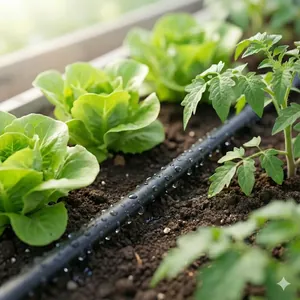
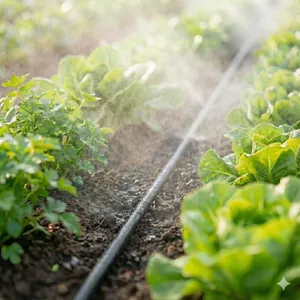
Fertigation is the simultaneous delivery of water and dissolved fertilizers through a drip system. Compared to manual application at the root zone or foliar feeding, it provides:
- 25–40% fertilizer savings — nutrients are delivered precisely to the root zone without leaching losses
- Uniformity — every plant receives the same dose (with a quality system at Cv ≤ 0.05)
- Precise control — EC and pH are adjusted to match the growth phase (vegetative vs. flowering vs. fruiting)
- Yield increase — 15–30% for field vegetables, up to 50% in greenhouses (per FAO-56 and ISHS data)
Injector types: choosing equipment
Venturi injector (passive)
A plastic or metal tube with a constriction that creates a vacuum (Venturi effect). It draws the solution from a tank through a tube.
Pros:
- Affordable: UAH 500–3,000
- No moving parts — long-lasting
- Runs without electricity
Cons:
- 20–30% pressure loss (0.5–1.0 bar drop across the injector)
- Unstable dosing — depends on pressure and flow
- Requires a bypass line to compensate for the pressure loss
Best for: Home gardens, greenhouses up to 200 m², small farm plots up to 0.5 ha. Models: Mazzei, MixRite Venturi.
Dosatron/MixRite dosing pump (hydraulic)
A pump driven by the water flow (no electricity). Precise proportional delivery: 0.2–5% of the water flow with high stability.
Pros:
- Precise proportionality ±3% regardless of pressure and flow
- Minimal pressure loss (0.2 bar vs. 1.0 on a Venturi)
- Runs without electricity
- The commercial irrigation standard: Dosatron D25, D45, MixRite 2502, 5717
Cons:
- More expensive: UAH 8,000–35,000 depending on capacity
- Requires maintenance once every 1–2 years (seal replacement)
Best for: Greenhouses 200+ m², farms 0.5+ ha, seedling producers, commercial systems. Our recommended choice for serious projects.
Electric dosing pump (peristaltic/diaphragm)
An electric pump with a programmable controller. Often part of fertigation stations with EC/pH automation.
Pros:
- Highest accuracy — automatic real-time EC/pH correction
- Integration with Netafim NetaJet, Priva Nutri-Ject controllers
- Can deliver multiple solutions (A, B, acid) simultaneously
Cons:
- Expensive: from UAH 35,000 for a basic station, UAH 150,000+ for a professional unit
- Requires electricity and sensors (EC, pH)
- More complex to operate and configure
Best for: Commercial greenhouses, hydroponics, agricultural holdings with automation.
Fertilizer compatibility: what can be mixed
The key rule: Ca (calcium) and SO₄ (sulfates) or PO₄ (phosphates) in the same tank form precipitate that clogs emitters in a single irrigation cycle. Use separate tanks A and B:
| Tank A (calcium) | Tank B (sulfate-phosphate) |
|---|---|
| Ca(NO3)2 — calcium nitrate | KH2PO4 — monopotassium phosphate |
| KNO3 — potassium nitrate | K2SO4 — potassium sulfate |
| NH4NO3 — ammonium nitrate | MgSO4 — magnesium sulfate |
| Micronutrients in EDTA chelates | Micronutrients in DTPA chelates |
Rule: Stock solutions A and B are DELIVERED THROUGH SEPARATE INJECTORS or sequentially with the same pump. Never mix concentrates A+B in one tank — instant precipitate.
EC and pH: target values by crop
| Crop | EC (mS/cm) | pH | Notes |
|---|---|---|---|
| Tomatoes (fruiting) | 2.5–3.5 | 5.8–6.2 | Increased Ca for fruit wall strength |
| Cucumbers | 1.8–2.5 | 5.8–6.0 | High K during fruiting |
| Peppers, eggplant | 2.0–2.8 | 5.8–6.2 | Stable NPK, sensitive to Cl |
| Strawberries | 1.2–1.8 | 5.5–6.0 | Low EC, sensitive to salinity |
| Greens, lettuce | 1.0–1.5 | 5.8–6.5 | Minimum EC, rapid growth |
| Grapes | 1.5–2.2 | 6.0–6.5 | Increased K during ripening |
Preventing emitter clogging
- Flush: 15–20 min of clean water AFTER every fertigation cycle — without this, salt crystallizes in the emitters
- Acid shock treatment: Once a month, run HNO₃ at pH 2 through the system for 30 min — dissolves Ca/Mg deposits
- Chlorination for biofilm: Shock chlorination at 5–10 ppm NaOCl for 1 hour once per season — kills algae and bacteria
- 150 mesh filter: Must be installed AFTER the injector — catches undissolved fertilizer particles
- End-of-line flush valve: An automatic flush valve at the end of the mainline once a day — removes accumulated sediment
For commercial greenhouses and farms
Commercial fertigation is a separate engineering system, not just an injector:
- Automated fertigation station: Netafim NetaJet, Priva Nutri-Ject, Dosatron MultiFert — simultaneous delivery of 3–5 solutions (A, B, acid, micronutrients)
- Measurement node: EC/pH sensors (Bluelab, Hanna) + controller with automatic pH acid correction
- Water analysis BEFORE design: Ca/Mg/HCO₃ content determines how much acid is needed for pH correction
- Laboratory leaf and soil analysis — NPK adjustments every 2–4 weeks based on results
- Standards: ASABE EP405 (microirrigation design, including fertigation), ISO 9261 (emitters), FAO Irrigation and Drainage Paper 36 recommendations
- Anti-siphon and check valve — a legal requirement in most EU countries to prevent fertilizer from entering the drinking water supply
Planning to implement fertigation?
Our catalog includes injectors, dosing pumps, filters, and consumables for fertigation.