

How to properly choose drip tape for your garden
Detailed guide for choosing optimal drip tape. Examining thickness, emitter spacing, water flow and other characteristics.
What is drip tape?
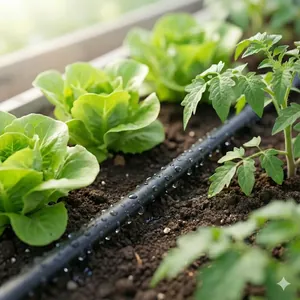
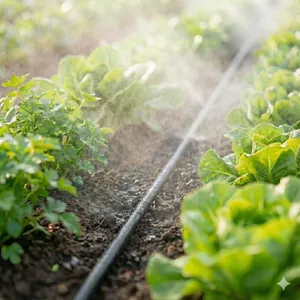
Drip tape is flat polyethylene hose with built-in drippers (emitters) providing precise plant watering directly to roots. Proper tape selection saves up to 70% water and increases yield 30-50% compared to regular watering.
Interesting fact: Drip tape invented in Israel in 1960s and now used in 90+ countries worldwide for irrigating over 10 million hectares of agricultural land.
Main selection criteria
Tape wall thickness
Thickness measured in mils or millimeters. This is most important parameter determining tape service life:
6 mil (0.15 mm) - Economy class
- Service life: 1-2 seasons
- For light sandy soils without stones
- Cost: lowest (from 200 UAH/100m)
- Suitable for: annual crops, test plots
8 mil (0.20 mm) - Recommended
- Service life: 3-4 seasons
- Universal option for most soil types
- Cost: medium (from 350 UAH/100m)
- Suitable for: all vegetable crops, strawberries, flowers
10-12 mil (0.25-0.30 mm) - Premium
- Service life: 4–6 seasons (up to 7 with mulch cover and no rodent contact)
- For heavy clay and rocky soils
- Cost: from UAH 600/100 m
- Suitable for: annual crops at a professional level, heavy soils
15 mil (0.38 mm) — Heavy-duty
- Service life: 5–7+ seasons with proper use
- For perennial plantings: orchards, vineyards, berry crops
- Maximum resistance to mechanical damage and rodents
- Suitable for: farms, subsurface drip irrigation (SDI)
Expert tip: For private garden optimal choice is 8 mil tape - lasts 3-4 years and has best price/quality ratio. Economy 6 mil option needs annual replacement, which proves more expensive.
Emitter spacing (distance between drippers)
Distance between drippers determines moisture uniformity. Choose spacing according to crop type and plant distance:
| Emitter spacing | Crops | Features |
|---|---|---|
| 10 см | Carrots, onions, radishes, lettuce, greens | Dense planting, continuous row moistening |
| 15 см | Beets, cabbage, garlic, strawberries | Medium density, water savings |
| 20 см | Tomatoes, cucumbers, peppers, eggplants | Most popular option, universal |
| 30 см | Zucchini, pumpkins, watermelons, melons | Large distance between plants |
| 40-50 см | Potatoes, corn, sunflowers | Sparse planting, point watering |
Life hack: If growing different crops - buy tape with 20 cm spacing. This is most universal option suitable for 80% garden plants.
Water flow (l/hr per 1 emitter)
Water flow affects irrigation speed and system operating time. Choose flow according to soil type:
1.0-1.3 l/hr - Slow flow
For heavy clay soils with low water permeability
- Irrigation time: 45-60 minutes
- Water fully absorbed without puddles
- Minimum evaporation and runoff
1.6-2.0 l/hr - Standard flow
Universal option for sandy loam and loam soils
- Irrigation time: 30-40 minutes
- Optimal speed and quality ratio
- Suitable for 90% private farms
2.7-3.8 l/hr - Fast flow
For light sandy soils with high water permeability
- Irrigation time: 15-25 minutes
- Quick soil water saturation
- Time savings but greater overwatering risk
Important: High flow (3+ l/hr) on clay soil leads to puddles and water runoff. Low flow (1 l/hr) on sandy soil - very long irrigation (60+ minutes).
Row length and pressure compensation
The longer rows in your garden, the more water pressure drops at tape end. This leads to uneven watering:
Regular tape without compensation suitable. Flow difference between row start and end - up to 10%.
Pressure compensating tape recommended. Ensures uniform flow along entire length. Cost 30-50% higher.
Options: (1) tape with pressure-compensating (PC) emitters — allows single lines up to 150–200 m with uniform flow; (2) drip tubing Ø16–20 mm (thicker walls) instead of tape; (3) divide the system into zones with separate connections for each. Be sure to perform a hydraulic calculation in advance (pressure drop ≤ 20% of operating pressure).
How pressure compensation works: In PC tape, each emitter contains a flexible silicone diaphragm. Under pressure, it deforms and narrows the passage, maintaining a stable flow rate (~±5%) across a range of 0.6–4.0 bar. Standard tape without a diaphragm delivers different flow rates at the beginning and end of a long row — up to 20–30% variation. PC is needed for uneven terrain, greenhouses, and lines over 50 m; for a short 10–30 m bed, it is an unnecessary extra cost.
Tip: If your garden has rows over 50 meters - connect tape from both sides (row start and end). This ensures uniform pressure without overpaying for compensated tape.
Required quantity calculation
To properly calculate tape quantity for your garden:
- Measure each row length where planning drip irrigation
- Count number of rows
- Multiply length by number: length × rows = total length
- Add 10-15% reserve for trimming and connections
- Round to whole roll (100, 200, 500 or 1000 m)
Calculation example:
Garden 20 meters × 10 meters
Bed width: 0.9 m, number of beds: 10 pcs
Calculation:
20 м (довжина ряду) × 10 (рядів) = 200 м
200 м + 10% запас = 220 м
Need: 1 roll 200 m + 1 roll 50 m (or 300 m)
Savings: Large rolls (500-1000 m) cost 15-20% cheaper per meter. If need much tape - buy one large roll instead of several small ones.
Popular options comparison table
| Parameters | Economy | Standard (Recommended) | Premium | Heavy-duty |
|---|---|---|---|---|
| Thickness | 6 mil (0.15 мм) | 8 mil (0.20 мм) | 10-12 mil (0.25-0.30 мм) | 15 mil (0.38 мм) |
| Emitter spacing | 20-30 см | 10-30 см | 10-30 см | 20-50 см |
| Flow | Selected by soil type, independent of class: 1.0–1.3 L/h (clay), 1.6–2.0 L/h (universal), 2.7–3.8 L/h (sand) | |||
| Service life | 1-2 сезони | 3-4 сезони | 4-6 сезонів | 5-7+ сезонів |
| Cost (100m) | від 200 грн | від 350 грн | від 600 грн | made to order |
| For whom | Testing, annual use | Private garden, cottage | Professional use, heavy soils | Orchards, vineyards, SDI, agricultural holdings |
Additional expert tips
- For greenhouses use tape with maximum spacing (30-40 cm) - less evaporation and soil retains moisture better
- Cover tape with mulch (straw, black film) - extends service life and reduces mechanical damage risk
- Always use a filter of at least 150 mesh at the system inlet - drip tape emitters are very sensitive to contaminants
- Buy tape from one manufacturer for entire garden - easier to select accessories and connectors
- Store tape indoors in winter, rolled up - frost and UV rays shorten service life
For farms and agricultural holdings
When selecting tape for large-scale production (hectares, hundreds of long lines), a different approach is needed:
- Professional brands with ISO 9261 certification: Netafim, Rivulis (Ro-Drip, T-Tape), Eurodrip, Irritec P1, Chapin. Cv (flow rate coefficient of variation) ≤ 0.05 for uniform irrigation
- Pressure-compensating (PC) lines for terrain or lines over 100 m. Without PC, flow variation over 100 m can reach 20–30%
- Anti-root / anti-siphon emitters — protection against soil ingestion when irrigation stops (especially for subsurface drip — SDI)
- Thickness: 8–10 mil for annual crops (tomatoes, cucumbers, peppers), 15 mil (0.38 mm) for perennial orchards and vineyards
- Fertigation is mandatory for B2B: drip tape is ideal for applying soluble fertilizers along with irrigation (30% fertilizer savings)
- Large rolls of 1,000–3,000 m are the field standard. Factory packaging is 20–25% cheaper than retail
Wholesale pricing applies for orders starting at 5,000 m. Our engineer will calculate the flow rate, select emitter spacing by crop, and recommend the thickness for your soil type.
Ready to choose drip tape?
Our catalog features drip tapes of various thickness, spacing and flow from verified manufacturers.