

How to choose a sprinkler: spray, rotor, MP Rotator, and impulse
A complete comparison guide: radius, pressure, precipitation rate, application. Practical selection criteria for lawns, gardens, and landscapes.
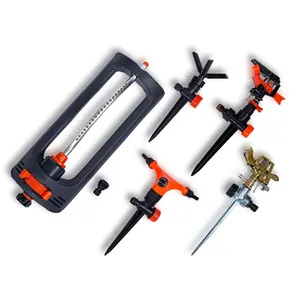
Four main sprinkler types
An incorrectly chosen sprinkler type is the #1 cause of uneven watering, waterlogging, and dry spots. Below is a comparison of 4 technologies by key parameters.
Rule #1: Only one head type per irrigation zone. Spray + rotor in the same zone will cause overwatering in one area and dry patches in another (different precipitation rates).
Comparison table
| Parameter | Spray (pop-up) | Rotor | MP Rotator | Impulse |
|---|---|---|---|---|
| Radius | 3–5 м | 5–15 м | 4–10 м | 8–20 м |
| Operating pressure | 2–2.5 бар | 3–4 бар | 2.5–3 бар | 3–4 бар |
| Precipitation rate | 20–40 мм/год | 8–12 мм/год | 10–12 мм/год | 15–25 мм/год |
| Water flow rate | 3–8 л/хв | 4–15 л/хв | 1–5 л/хв | 10–25 л/хв |
| Wind resistance | Low | Medium | High | Medium |
| Time to apply 1 inch of water | 15–25 хв | 50–75 хв | 50–60 хв | 25–35 хв |
| Price per unit | 150–400 грн | 400–1200 грн | 500–900 грн | 200–600 грн |
| Best for | Flower beds, narrow strips | Large lawns | Landscape design | Fields, vegetable gardens |
Detailed breakdown by type
Spray (pop-up)
Fixed heads with a stationary fan-shaped stream. They rise from the ground under pressure and retract when turned off. The cheapest and simplest type.
Advantages:
- Low pressure (2–2.5 bar) — works from municipal supply without a pump station
- Simple to install and maintain
- Low price — UAH 150–400 per head
- Matched nozzles (MP Rotator / Hunter MSBN / Rain Bird U-series) equalize precipitation rate at different arcs
Drawbacks:
- High precipitation rate (20–40 mm/h) — risk of soil erosion and runoff
- Fine droplets, blown by wind > 2 m/s (losses up to 30%)
- Small radius — for areas up to 5 m
Application: Flower beds, narrow strips along walkways, small lawns up to 100 m², spot irrigation near the house.
Rotor (pop-up)
Heads with a rotating stream (single or multiple jets) moving across a 40°–360° arc. The standard for large lawns and sports fields.
Advantages:
- Large radius 5–15 m — covers up to 700 m² from a single circuit
- Low precipitation rate (8–12 mm/h) — soil absorbs water in time
- Large droplets — less evaporation loss
- Adjustable arc and radius without nozzle replacement
Drawbacks:
- Higher pressure 3–4 bar — requires a booster or good water supply
- Long watering time (50–75 min for 25 mm of water)
- More expensive (UAH 400–1,200)
Application: Lawns 100+ m², sports fields, parks. Professional series: Hunter PGP/I-20, Rain Bird 5000/5500, Toro T5/T7.
MP Rotator (multi-stream rotating nozzle)
A hybrid of spray and rotor: a nozzle that mounts on a spray head body but produces 4–8 rotating streams. Invented by Hunter, now available from Rain Bird, K-Rain, and others.
Advantages:
- Lowest precipitation rate (10–12 mm/h) — minimal runoff on clay soils
- Large droplets — wind resistant
- Matched precipitation rate at different arcs and radii — you can mix arcs within a single zone
- 30% water savings vs. spray nozzles
- Works at 2.5 bar — fits existing spray systems without rebuilding
Drawbacks:
- More expensive than spray nozzles (UAH 500–900)
- Long watering time (50–60 min for 25 mm of water)
Application: Landscape design, complex lawn shapes, clay soils, areas with limited pressure. An upgrade for existing spray systems without rebuilding.
Impulse
Metal heads with a pulsating stream and the characteristic "tick-tick" sound. Mounted on a tripod or threaded connection. Often portable.
Advantages:
- Largest radius (up to 20 m) — covers a large area from a single source
- Sturdy metal construction — long-lasting
- Portable tripod models — a mobile solution without digging
- Affordable — UAH 200–600
Drawbacks:
- High flow rate 10–25 L/min — requires a powerful water supply
- Not for permanent pop-up systems (primarily above-ground)
- Noisy operation
Application: Vegetable gardens, large fields, agricultural plots, temporary irrigation, properties without an installed system.
Quick selection matrix
- Radius up to 5 m + flower beds: spray (pop-up) with matched nozzles
- Lawn 100–500 m², pressure 3+ bar: rotor (Hunter PGP, Rain Bird 5000)
- Complex landscape / clay / pressure 2.5 bar: MP Rotator
- Vegetable garden, field, mobile solution: impulse on a tripod
- Windy location: MP Rotator or rotor (large droplets)
- Limited budget, small lawn: spray pop-up with basic nozzles
For landscaping companies and sports fields
When designing professional irrigation systems:
- Hydrozoning by water demand: lawn, shrubs, flower beds — separate zones with different precipitation rates
- Head-to-head coverage (100% overlap): sprinkler spacing = throw radius; otherwise dry corners
- Check valve (SAM — Seal-A-Matic) on models installed on slopes — prevents low-head drainage after watering
- Pressure-regulating stem (PRS) — stabilizes pressure at the head, critical for equal precipitation
- ANSI/ASAE S398.1 and S436.1 — standards for sprinkler testing and uniformity coefficient calculation (DUlq ≥ 0.75 for quality design). ISO 15886-1/-3 — rotary sprinkler specifications.
Ready to choose sprinklers?
Our catalog offers sprinklers of all types from budget to professional Hunter, Rain Bird, and Toro series.