

B2B
Drip irrigation for vegetable fields
Specifics of irrigating tomatoes, cucumbers, peppers, and cabbage in open ground. Rates per hectare, fertigation schedules, and mistakes.
0.1-10 ha
Range
ETc
Calculation
35 min
Reading time
+40%
Yield
General approach to vegetable fields
- Beds 1.5 m wide (1 m bed + 0.5 m path) — standard for mechanized cultivation
- Black plastic mulch 40 µm — 40% water savings, no weeds
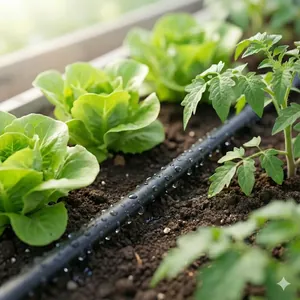
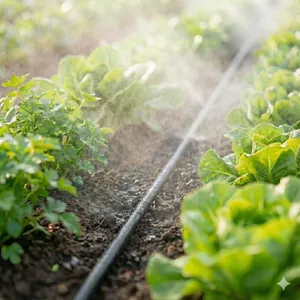
- 8 mil drip tape UNDER the mulch with 20 cm emitter spacing and 1.6 L/h flow rate
- Fertigation is mandatory — manual fertilizer application on a drip-irrigated field loses 60% of its effectiveness
- Row layout across the slope — uniform water distribution, minimal erosion
Tomatoes
Strategy:
- Density: 30,000–40,000 plants/ha (30–40 cm in-row spacing, 1.5 m between rows)
- 1 tape line per bed down the center (both plant rows are moistened by lateral water movement)
- Water consumption per hectare: 5–7 mm/day at peak (50–70 m³/ha)
- Morning irrigation 5:00–9:00 AM to reduce air humidity
- DO NOT water from above — late blight within 3–5 days
Irrigation schedule by phase:
| Phase | Duration | Rate, m³/ha/day | Frequency |
|---|---|---|---|
| Transplanting – flowering | 2–3 weeks | 25-35 | Every other day |
| Flowering – fruit set | 3–4 weeks | 40-50 | Daily |
| Peak fruiting | 6–8 weeks | 55-70 | Daily or twice/day |
| End of fruiting | 2–3 weeks | 30-40 | Every other day |
Fertigation:
- Vegetative phase: EC 2.0, pH 5.8, emphasis on N (NH₄NO₃, Ca(NO₃)₂)
- Fruiting: EC 2.5–3.5, pH 5.8, emphasis on K (KNO₃, K₂SO₄) + Ca for fruit firmness
- Excess N during fruiting = cracked fruit, poor storage quality
Cucumbers
Strategy:
- Density: 40,000–60,000 plants/ha (25 cm in-row spacing)
- Tape with 20 cm spacing, 1.6 L/h flow rate
- Water consumption: 6–8 mm/day at peak (up to 80 m³/ha)
- Very sensitive to drying out — fruit becomes bitter
- Works ideally with straw or plastic mulching
Rates:
- Transplanting: 25–30 m³/ha every other day
- Flowering–fruit set: 50–60 m³/ha daily
- Fruiting: 70–80 m³/ha daily; in heat, twice/day
Fertigation:
- EC 1.8–2.5, pH 5.8–6.0
- High K during fruiting — sweet and crisp cucumbers
- Sensitive to chlorides — do not use KCl
Sweet peppers and eggplant
- Density: 30,000–45,000 plants/ha
- Tape spacing 20 cm, flow rate 1.6 L/h
- Consumption: 4–6 mm/day at peak (40–60 m³/ha)
- Sensitive to stress from irregular watering — fruit drop
- Important — warm water 18–22°C, not directly from the well
Fertigation:
- EC 2.0–2.8, pH 5.8–6.2
- Stable NPK, high Ca demand to prevent blossom-end rot
- Avoid large doses of ammonium N — root toxicity risk
White cabbage
- Density: 30,000–45,000 plants/ha (60 cm in-row × 50 cm between rows)
- Tape spacing 30 cm — matches the plant spacing
- Water consumption: very high — 6–10 mm/day (60–100 m³/ha)
- Heads crack with irregular watering — maintain consistency
- Deep root system — can water less frequently but longer
Fertigation:
- EC 2.2–2.5, pH 6.0–6.5
- High N during the vegetative phase (before head formation)
- K during the head phase — density and storage quality
- Mo and B are important — deficiency causes head deformation
Potatoes
- Density: 40,000–60,000 plants/ha (70 cm between rows)
- Emitter spacing 30–40 cm (point irrigation for each plant)
- Consumption: 3–5 mm/day, 30–50 m³/ha/day
- Critical phases: flowering–tuber formation (maximum demand)
- Stop watering 2 weeks before harvest for storage quality
Fertigation:
- EC 1.8–2.2, pH 5.5–6.0
- High K — large, sweet tubers
- Moderate N — excess = vigorous foliage, small tubers
Annual water budget per hectare
| Crop | Seasonal water consumption, m³/ha | Fertigation costs, UAH/ha | Expected yield, t/ha |
|---|---|---|---|
| Tomatoes | 4000-6000 | 30-50 тис. | 60-120 |
| Cucumbers | 4500-6500 | 25-45 тис. | 50-90 |
| Peppers | 3500-5000 | 35-55 тис. | 40-70 |
| Cabbage | 5500-8000 | 25-40 тис. | 60-100 |
| Potatoes | 3000-4500 | 20-35 тис. | 35-50 |
Common mistakes on farm fields
- Using sprinklers for fruiting crops: late blight, grey mold, 30–50% crop loss
- Cold well water: stress for tomatoes and peppers. A 5–10 m³ warming tank is mandatory
- Tape on top of mulch: UV degradation within 1 season. Under mulch — 3–4 seasons
- Fertigation for 100% of watering time: stock solution is not flushed out — deposits in the tape. Always run 15 min of clean water after fertigation
- One schedule for all crops: tomatoes and cabbage require different rates and pH. Separate zones for different crops
Crop rotation and planning
- 4-field rotation: tomatoes/peppers → cucumbers → potatoes/onions → cabbage/greens. Prevents pathogen buildup
- Reused tape lasts 2–3 seasons with the same crop. When switching crops, change the spacing or use a new roll
- Mainline and filtration are shared across all crops — a 10–20 year investment